What is the lifespan of bearings?
As a bearings supplier, I've encountered numerous clients who frequently inquire about the lifespan of bearings. The lifespan of bearings is a critical aspect that can significantly impact the performance and cost - effectiveness of various machinery. It's not a one - size - fits - all answer, as multiple factors come into play when determining how long a bearing will last.
To begin with, the type of bearing has a direct influence on its lifespan. There are different types of bearings, including ball bearings, roller bearings, and slewing bearings. Ball bearings, which use balls to maintain separation between moving parts, are commonly used in applications where high - speed rotation is required. They generally have a relatively long lifespan under normal operating conditions. For instance, in small electric motors, ball bearings can last for thousands of hours.
Roller bearings, on the other hand, use cylindrical, tapered, or spherical rollers. They are capable of handling heavier loads compared to ball bearings. However, due to the larger contact area and the nature of the loads they carry, their lifespan might be affected differently. In heavy - duty industrial equipment, such as conveyor systems, roller bearings may need to be replaced more frequently if they are constantly subjected to high - stress conditions.
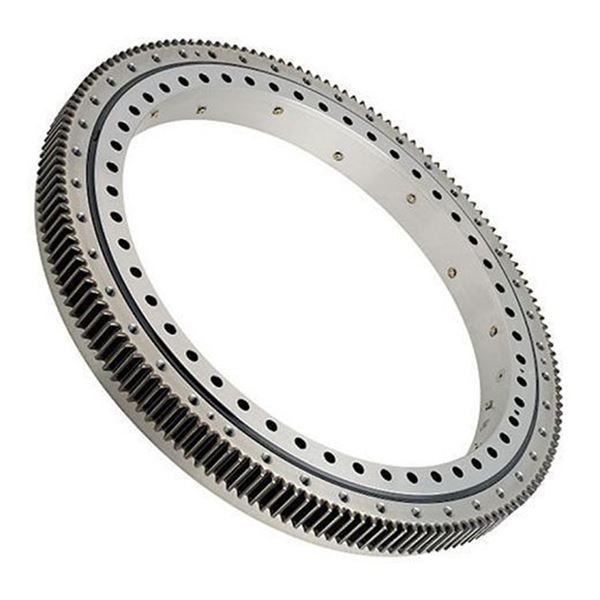
Slewing bearings are designed to handle axial, radial, and moment loads simultaneously. They are widely used in applications like Excavator Slewing Bearings and Tower Crane Slewing Bearings. The lifespan of slewing bearings can vary greatly depending on the working environment and the load they bear. In construction sites, where excavators and tower cranes operate under harsh conditions, slewing bearings need to be of high quality and well - maintained to ensure a reasonable lifespan.
Another crucial factor is the operating conditions. Temperature plays a vital role. High temperatures can cause the lubricant in the bearing to break down, leading to increased friction and wear. For example, in some industrial ovens or engines, bearings are exposed to extremely high temperatures. In such cases, special high - temperature lubricants and heat - resistant bearing materials are required to extend the bearing's lifespan.
Conversely, low temperatures can also have a negative impact. At very low temperatures, the lubricant may become too viscous, reducing its ability to lubricate effectively. This can result in premature wear of the bearing components.
The level of contamination is also a significant concern. Dust, dirt, and other particles can enter the bearing and act as abrasives, accelerating wear. In mining or agricultural applications, where machinery is often exposed to dusty environments, proper sealing is essential to protect the bearings. If the seals are damaged or not effective enough, contaminants can easily enter the bearing and reduce its lifespan.
Load is yet another factor. Overloading a bearing can cause excessive stress on the rolling elements and raceways. This can lead to fatigue failure, where cracks develop on the surface of the bearing components and eventually cause the bearing to fail. It's important to select a bearing with a load - carrying capacity that matches the requirements of the application.
Lubrication is the lifeblood of bearings. Adequate lubrication reduces friction, dissipates heat, and protects the bearing surfaces from corrosion. There are different types of lubricants, such as grease and oil. Grease is commonly used in applications where the bearing speed is relatively low and the operating environment is not too harsh. Oil lubrication is preferred for high - speed and high - temperature applications.
The quality of the lubricant and the frequency of lubrication also matter. Using a low - quality lubricant may not provide sufficient protection, while improper lubrication intervals can lead to insufficient lubrication. For example, if a bearing requires re - lubrication every 500 hours of operation, but it is only lubricated every 1000 hours, the bearing will experience increased wear.
Maintenance practices can significantly extend the lifespan of bearings. Regular inspections can help detect early signs of wear, such as abnormal noise, vibration, or temperature changes. By identifying these issues early, corrective actions can be taken, such as replacing worn - out components or adjusting the operating conditions.
Proper installation is also crucial. Incorrect installation can cause misalignment, which can lead to uneven loading on the bearing. This can result in premature wear and failure. It's important to follow the manufacturer's installation guidelines to ensure that the bearing is installed correctly.
In terms of theoretical calculations, the basic rating life of a bearing is often used as a reference. The basic rating life is defined as the number of revolutions or hours of operation that 90% of a group of identical bearings can withstand before the first signs of fatigue failure occur under specific load and operating conditions. However, it should be noted that this is just a theoretical value, and the actual lifespan can deviate significantly due to the factors mentioned above.

In real - world applications, it's not uncommon to see bearings lasting anywhere from a few hundred hours to tens of thousands of hours. For example, in a well - maintained automotive engine, the bearings may last for 100,000 miles or more. In contrast, in a heavy - duty industrial machine operating under harsh conditions, the bearings may need to be replaced every few thousand hours.
As a bearings supplier, we understand the importance of providing high - quality bearings and offering expert advice on bearing selection, installation, and maintenance. We have a wide range of bearings to meet the diverse needs of different industries. Whether you are in the construction, automotive, or manufacturing sector, we can help you find the right bearings for your applications.
If you are looking for reliable bearings and want to ensure a long lifespan for your machinery, don't hesitate to contact us for a detailed consultation. Our team of experts can assist you in selecting the most suitable bearings, providing guidance on proper installation and maintenance, and answering any questions you may have about bearing lifespan. We are committed to helping you optimize the performance of your equipment and reduce downtime and maintenance costs.
References
- Harris, T. A., & Kotzalas, M. N. (2007). Rolling Bearing Analysis. Wiley.
- American Bearing Manufacturers Association (ABMA). (2018). Standards for rolling bearings.