

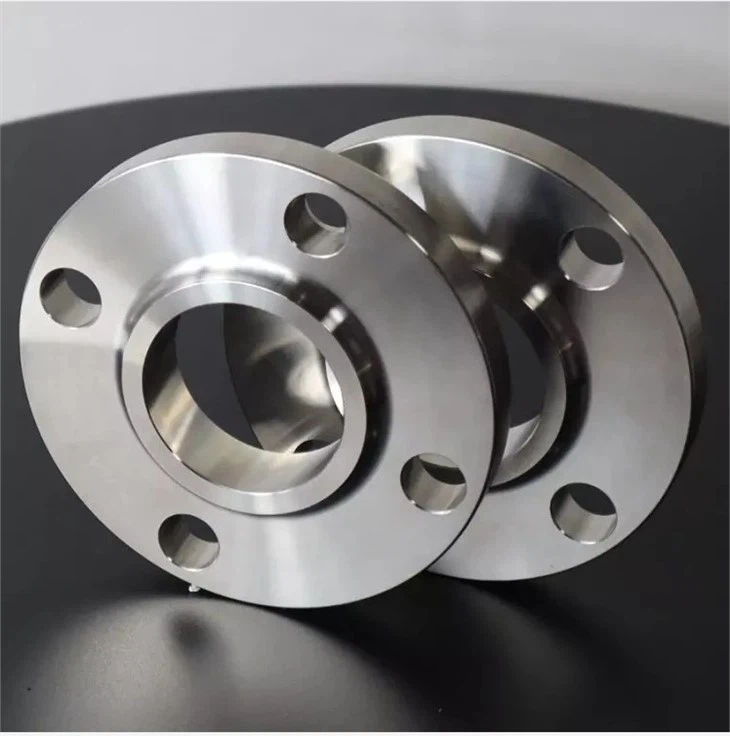
Hey there! I'm a supplier of Slip On Flanges, and I know how crucial it is to ensure the quality of these products. Hidden defects in Slip On Flanges can lead to all sorts of problems down the line, like leaks, system failures, and even safety hazards. So, in this blog, I'm gonna share some tips on how to detect those sneaky hidden defects.
Visual Inspection
The first step in detecting hidden defects is a good old - fashioned visual inspection. You don't need any fancy equipment for this one. Just take a close look at the flange. Check for any obvious signs of damage, like cracks, chips, or dents. Cracks can be a major issue as they can propagate over time and cause the flange to fail. Look at the surface finish as well. A rough or uneven surface might indicate poor manufacturing processes, which could lead to hidden problems.
For example, if you notice any rust spots on the flange, it could be a sign of corrosion. Even if the rust seems minor, it might be hiding deeper - seated issues within the metal. Also, pay attention to the alignment of the holes. Misaligned holes can cause problems during installation and might be a sign of manufacturing errors.
Dimensional Checks
Next up, we've got dimensional checks. Slip On Flanges need to meet specific size requirements to work properly. You can use basic measuring tools like calipers and micrometers to check the critical dimensions. Measure the outer diameter, inner diameter, and the thickness of the flange. Compare these measurements with the specifications provided by the industry standards or the customer's requirements.
If the dimensions are off, it could lead to improper fitting. For instance, if the inner diameter is too small, it might not fit over the pipe properly, and if it's too large, it could result in a loose connection. Make sure to check the bolt hole diameter and spacing as well. Incorrect bolt hole dimensions can prevent the flange from being properly secured.
Non - Destructive Testing (NDT)
When it comes to detecting hidden defects that aren't visible to the naked eye, non - destructive testing methods are your best friends. There are several NDT techniques that can be used for Slip On Flanges.

Ultrasonic Testing (UT)
Ultrasonic testing is a popular method. It uses high - frequency sound waves to detect internal flaws in the material. A transducer sends ultrasonic waves into the flange, and if there's a defect, like a crack or a void, the waves will reflect back differently. By analyzing these reflections, technicians can determine the size, location, and nature of the defect.
This method is great because it can detect defects deep within the flange without causing any damage to the product. It's especially useful for detecting flaws that might not be visible on the surface, such as internal cracks or laminations.
Magnetic Particle Testing (MT)
Magnetic particle testing is another useful NDT method, but it's mainly suitable for ferromagnetic materials, which most Slip On Flanges are made of. In this process, a magnetic field is applied to the flange, and then iron particles are sprinkled on the surface. If there's a surface or near - surface defect, the magnetic field will be disrupted, and the iron particles will accumulate at the defect site, making it visible.
MT is a quick and relatively inexpensive way to detect surface - breaking cracks. It's a great option when you suspect that there might be some surface - level issues with the flange.
Liquid Penetrant Testing (PT)
Liquid penetrant testing is also used to detect surface - opening defects. First, a liquid penetrant is applied to the surface of the flange and allowed to seep into any cracks or pores. After a certain period, the excess penetrant is removed, and a developer is applied. The developer draws the penetrant out of the defects, making them visible as bright indications against the background.
This method is highly sensitive and can detect very small surface defects. It's useful for detecting hairline cracks that might not be easily seen during a visual inspection.
Material Analysis
Knowing the material composition of the Slip On Flange is essential. You can use techniques like spectroscopy to analyze the chemical composition of the metal. This helps ensure that the flange is made of the right material and meets the required standards.
For example, if a flange is supposed to be made of a specific grade of stainless steel, material analysis can confirm whether it actually contains the correct elements in the right proportions. Incorrect material composition can lead to reduced strength, corrosion resistance, and overall performance of the flange.
Pressure Testing
Pressure testing is a practical way to check for hidden leaks and structural integrity. The flange is installed in a test setup, and a specified pressure is applied. The pressure is maintained for a certain period, and any drop in pressure could indicate a leak.
This test can help detect both visible and hidden leaks in the flange. It's a real - world simulation of how the flange will perform under pressure in an actual application. If there's a hidden defect that causes a leak, it will be revealed during this test.
Different Standards and Their Impact on Defect Detection
There are various standards for Slip On Flanges, such as JIS Slip On Flange, GB Slip - on Flange, and ANSI Slip On Flange. Each standard has its own set of requirements for manufacturing, quality control, and defect detection.
For example, JIS standards might have specific requirements for the surface finish and dimensional tolerances. When detecting defects, you need to make sure that you're following the relevant standard's guidelines. This ensures that the flange meets the expectations of customers in different regions and industries.
Conclusion
Detecting hidden defects in Slip On Flanges is a multi - step process that involves a combination of visual inspection, dimensional checks, non - destructive testing, material analysis, and pressure testing. By following these steps, you can ensure that the flanges you supply are of high quality and free from hidden defects.
If you're in the market for Slip On Flanges and want to ensure that you're getting top - notch products, don't hesitate to reach out. We're here to provide you with high - quality Slip On Flanges that meet all the necessary standards. Whether you need JIS Slip On Flange, GB Slip - on Flange, or ANSI Slip On Flange, we've got you covered. Let's start a conversation about your flange needs and how we can work together to ensure your projects run smoothly.
References
- ASME B16.5: Pipe Flanges and Flanged Fittings
- JIS B2220: Steel Pipe Flanges
- GB/T 9112 - 2010: Steel Pipe Flanges


