

Hey there! As a bearings supplier, I've been in the game for quite a while, and I often get asked about the standards for bearings. So, I thought I'd share my insights on this topic.
First off, let's talk about why standards are so important. Standards ensure that bearings meet certain quality and performance criteria. This is crucial because bearings are used in a wide range of applications, from small household appliances to heavy - duty industrial machinery. If a bearing doesn't meet the right standards, it can lead to premature failure, increased maintenance costs, and even safety hazards.
Material Standards
The material used to make a bearing has a huge impact on its performance. Most bearings are made from high - quality steel, such as chrome steel or stainless steel. Chrome steel is a popular choice because it offers excellent hardness, wear resistance, and fatigue strength. Stainless steel, on the other hand, is used when corrosion resistance is a key requirement, like in food processing equipment or marine applications.
The steel used in bearings should have a uniform microstructure. Any impurities or inconsistencies in the material can weaken the bearing and reduce its lifespan. For example, if there are small inclusions in the steel, they can act as stress concentrators, leading to crack initiation and eventual failure.
Dimensional Standards
Dimensional accuracy is another critical aspect of bearing standards. Bearings need to have precise dimensions to fit properly into their intended applications. The inner diameter, outer diameter, and width of a bearing must be within a specified tolerance range.
For instance, in automotive engines, bearings need to fit snugly around the crankshaft. If the inner diameter of the bearing is too large, it can cause excessive play, leading to vibration and noise. On the other hand, if it's too small, it can cause over - tightening, which may result in overheating and premature wear.
There are also standards for the roundness and cylindricity of the bearing surfaces. A perfectly round and cylindrical bearing surface ensures smooth rotation and even distribution of loads. Deviations from these standards can lead to uneven wear and reduced performance.
Tolerance Standards
Tolerance refers to the allowable variation in a bearing's dimensions or other characteristics. There are different types of tolerances, such as radial clearance tolerance and geometric tolerance.
Radial clearance is the amount of free movement between the inner and outer rings of a bearing. It's important to have the right amount of radial clearance. Too much clearance can cause noise and vibration, while too little can lead to overheating and premature failure. The tolerance for radial clearance is specified based on the bearing's size and application.
Geometric tolerances, such as straightness and flatness, are also crucial. These tolerances ensure that the bearing components are properly aligned and that the bearing can function as intended.
Performance Standards
Performance standards define how a bearing should perform under specific conditions. This includes factors like load - carrying capacity, speed rating, and lubrication requirements.
The load - carrying capacity of a bearing is the maximum load it can withstand without experiencing excessive deformation or failure. It depends on the bearing's design, material, and size. For example, heavy - duty industrial bearings used in mining equipment need to have a high load - carrying capacity to handle the large forces involved.
The speed rating of a bearing indicates the maximum rotational speed at which it can operate safely. Exceeding the speed rating can cause the bearing to overheat, leading to damage. The speed rating is determined by factors such as the bearing's design, lubrication, and the type of load it's subjected to.
Proper lubrication is essential for bearing performance. Lubrication reduces friction, dissipates heat, and protects the bearing from corrosion. There are standards for the type of lubricant to be used, as well as the amount and frequency of lubrication.
Application - Specific Standards
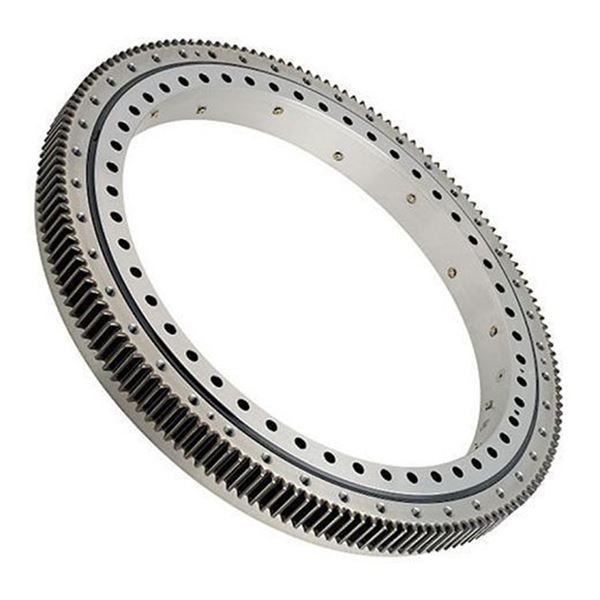
Different applications have their own unique requirements, and there are standards tailored to these applications. For example, in the construction industry, Excavator Slewing Bearings and Tower Crane Slewing Bearings need to meet specific standards.
Excavator slewing bearings are used to enable the rotation of the excavator's upper structure. They need to have high load - carrying capacity, good shock resistance, and reliable sealing to prevent dirt and debris from entering the bearing. Tower crane slewing bearings, on the other hand, are designed to support the heavy loads of the crane's jib and counterweight while allowing smooth rotation.
In the aerospace industry, bearings need to meet extremely strict standards due to the high - risk nature of the applications. They need to be lightweight, have high reliability, and be able to operate under extreme conditions, such as high temperatures and low pressures.
International Standards
There are several international organizations that set standards for bearings. One of the most well - known is the International Organization for Standardization (ISO). ISO standards are widely recognized and followed around the world. They cover a wide range of aspects, from material specifications to performance requirements.
Another important organization is the American Bearing Manufacturers Association (ABMA). ABMA standards are commonly used in the United States and are also influential globally. These standards provide detailed guidelines for bearing design, manufacturing, and testing.

How We Ensure Compliance
As a bearings supplier, we take standards very seriously. We work closely with our manufacturing partners to ensure that all our bearings meet or exceed the relevant standards.
We source our materials from reputable suppliers who adhere to strict quality control measures. Our manufacturing processes are carefully monitored to ensure dimensional accuracy and proper heat treatment. We also conduct extensive testing on our bearings to verify their performance.
Before a batch of bearings is shipped to our customers, it undergoes a series of quality checks. This includes dimensional inspections, hardness testing, and performance testing. We use advanced equipment and techniques to ensure that our bearings meet the highest standards.
Why Choose Our Bearings
When you choose our bearings, you can be confident that you're getting a product that meets the strictest standards. Our bearings are designed and manufactured to provide reliable performance in a wide range of applications.
We have a wide selection of bearings to choose from, including Excavator Slewing Bearings and Tower Crane Slewing Bearings. Whether you need a bearing for a small - scale project or a large - scale industrial application, we've got you covered.
Our team of experts is always available to provide technical support and advice. We can help you select the right bearing for your specific needs and ensure that it's installed and maintained correctly.
Let's Talk
If you're in the market for bearings and want to learn more about our products or have any questions about bearing standards, don't hesitate to reach out. We're here to help you find the best bearing solutions for your applications. Contact us to start a conversation about your bearing requirements and let's work together to ensure your projects run smoothly.
References
- International Organization for Standardization (ISO) standards
- American Bearing Manufacturers Association (ABMA) standards
- Industry - specific technical literature on bearing applications


