

Thin-walled shaft forgings are crucial components in various industries, including automotive, aerospace, and machinery manufacturing. As a shaft forgings supplier, I have extensive experience in the forging processes of thin-walled shaft forgings. In this blog, I will delve into the different forging processes used for thin-walled shaft forgings, their advantages, and considerations.
Open Die Forging
Open die forging is one of the traditional methods used for manufacturing thin-walled shaft forgings. In this process, the metal billet is placed between two flat or shaped dies, and pressure is applied to deform the metal. For thin-walled shaft forgings, open die forging can be used to achieve the initial shaping and to refine the grain structure of the metal.
The main advantage of open die forging is its flexibility. It can be used to produce shafts of various sizes and shapes, and it allows for the adjustment of the forging process according to the specific requirements of the thin-walled shaft. However, open die forging also has some limitations. It may not be suitable for producing shafts with very complex geometries, and the dimensional accuracy may be lower compared to other forging processes.
During open die forging of thin-walled shaft forgings, it is important to control the forging pressure and the deformation rate. Excessive pressure can cause the thin wall to collapse or crack, while insufficient pressure may result in incomplete shaping. Additionally, proper lubrication is necessary to reduce friction between the dies and the metal, which helps to prevent surface defects on the forging.
Closed Die Forging
Closed die forging, also known as impression die forging, is another common process for thin-walled shaft forgings. In this process, the metal billet is placed in a die cavity that has the desired shape of the final forging. The dies are then closed, and pressure is applied to force the metal to fill the cavity.
Closed die forging offers several advantages for thin-walled shaft forgings. It can produce forgings with high dimensional accuracy and complex geometries. The process also results in a more uniform grain structure, which improves the mechanical properties of the shaft. Moreover, closed die forging can be automated, which increases the production efficiency and reduces the labor cost.
However, closed die forging requires the use of expensive dies, which can be a significant investment, especially for small production volumes. The design of the dies is also critical, as any defects in the die cavity can be transferred to the forging. In addition, the thin wall of the shaft may be more prone to cracking during the forging process if the die design is not optimized.
To ensure the quality of thin-walled shaft forgings produced by closed die forging, it is essential to conduct thorough die design and simulation. Computer-aided design (CAD) and computer-aided manufacturing (CAM) technologies can be used to optimize the die geometry and to predict the forging process. Non-destructive testing methods, such as ultrasonic testing and magnetic particle testing, can also be employed to detect any internal defects in the forgings.
Roll Forging
Roll forging is a process in which the metal billet is passed through a pair of rotating rolls with shaped grooves. The rolls apply pressure to the billet, causing it to elongate and take on the shape of the grooves. Roll forging can be used to produce thin-walled shaft forgings with a relatively simple cross-sectional shape.
One of the main advantages of roll forging is its high production efficiency. It can produce forgings continuously, which is suitable for large-scale production. Roll forging also results in a good surface finish and a uniform grain structure along the length of the shaft.
For thin-walled shaft forgings, roll forging requires precise control of the roll speed, the reduction ratio, and the temperature of the metal. The thin wall of the shaft needs to be protected from excessive deformation, which can lead to wall thinning or cracking. Special roll designs may be required to ensure the proper shaping of the thin-walled section.
Precision Forging
Precision forging is a relatively new and advanced process for thin-walled shaft forgings. It combines the advantages of closed die forging and other precision manufacturing techniques to produce forgings with extremely high dimensional accuracy and surface quality.
Precision forging often involves the use of advanced technologies, such as hot isostatic pressing (HIP) and cold forging. HIP can be used to eliminate internal voids and improve the density of the forging, while cold forging can be used to achieve a high degree of precision in the final shaping.
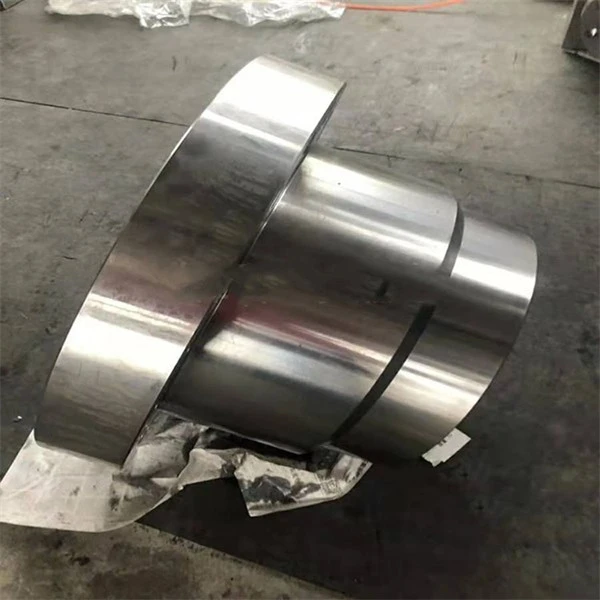

The precision forging process for thin-walled shaft forgings requires strict control of the forging parameters, including the temperature, the pressure, and the deformation sequence. The use of advanced materials and coatings on the dies can also help to improve the surface finish and the durability of the forgings.
Considerations for Thin - Walled Shaft Forging Processes
When choosing a forging process for thin-walled shaft forgings, several factors need to be considered.
Material Selection: Different materials have different forging properties. For example, some metals may be more prone to cracking during forging, while others may require specific heat treatment to achieve the desired mechanical properties. The material's flow characteristics also affect the choice of the forging process.
Production Volume: The production volume is an important factor in determining the most cost - effective forging process. For large production volumes, processes like closed die forging or roll forging may be more suitable due to their high production efficiency. For small production volumes, open die forging or precision forging may be a better option, as they offer more flexibility.
Design Complexity: The complexity of the shaft design, including the shape, the wall thickness, and the presence of features such as splines or flanges, influences the choice of the forging process. Complex designs may require more advanced processes like closed die forging or precision forging.
Related Forging Products
In addition to thin-walled shaft forgings, we also supply other types of forgings, such as Pressure Vessel Forgings, Disc Forging, and Tube Category Forgings. These forgings are used in a wide range of industries and applications, and we are committed to providing high - quality products to meet our customers' needs.
Conclusion
As a shaft forgings supplier, we understand the importance of choosing the right forging process for thin-walled shaft forgings. Each forging process has its own advantages and limitations, and the selection should be based on factors such as material, production volume, and design complexity. By leveraging our expertise and experience in forging technology, we can ensure the production of high - quality thin-walled shaft forgings that meet the strict requirements of our customers.
If you are interested in our thin-walled shaft forgings or other forging products, please feel free to contact us for procurement and negotiation. We are looking forward to collaborating with you to provide the best forging solutions for your specific applications.
References
- ASM Handbook Volume 14A: Forging. ASM International.
- Dieter, G. E. (1986). Mechanical Metallurgy. McGraw - Hill.
- Kalpakjian, S., & Schmid, S. R. (2008). Manufacturing Engineering and Technology. Pearson Prentice Hall.


